
Customer Service via WhatsApp: Practical Guide 2026

If your company receives more than 20 messages daily via WhatsApp or you need several agents to respond at the same time, the immediate action is to verify your company in Meta Business Manager and migrate to the WhatsApp Business API. If the volume is lower, activate welcome, away, and quick reply messages in the free app this week. Three signs that confirm you already need the API: more than one agent managing the same number, the need to send invoices or automatic reminders, or integration with your CRM or payment system.
Key Points
Implementing customer service via WhatsApp in Spain requires verification in Meta Business Manager, a DPA signed with the provider, and a conversational design with defined escalation criteria before launch.
| Point | Details |
|---|---|
| App vs API | Migrate to the API when you exceed 20 daily messages or need multi-agent and integrations. |
| Immediate Legal Obligation | Sign the DPA with your BSP and register opt-ins before sending the first message. |
| Design before Automating | Define flows and escalation criteria to a human before activating any chatbot. |
| Measurable ROI from the Start | Automating payment reminders reduces DSO from ~12 to ~5–6 days in SMEs. |
| Global Marketing and Commerce | Design, launch, and manage the complete channel with FIRE methodology and documented results. |
Table of Contents
- When do you need the API and when is the app enough?
- GDPR and WhatsApp in Spain: What you must document before launching
- How to choose between BSP, direct Cloud API, or a ready-made platform?
- What makes a conversational flow truly work?
- 4-week pilot plan for a risk-free launch
- KPIs and SLAs to govern the channel from day one
- Integrations that generate return from the first week
- Global Marketing and Commerce: from strategy to active channel
- What most people overlook when implementing this channel
- Sources
- Frequently asked questions
When do you need the API and when is the app enough?
The difference between the WhatsApp Business App and the WhatsApp Business API isn't just technical: it defines what kind of company you can be to your customers. The app is free, manual, and designed for freelancers or businesses with low volume. The API (Cloud API) allows for CRM and ERP integrations, workflow automation, multi-agent access, and sending pre-approved templates.
| Criterion | WhatsApp Business App | WhatsApp Business API (Cloud API) |
|---|---|---|
| Cost | Free | Based on conversation category + BSP or development |
| Multi-agent | No | Yes |
| Automation | Basic (welcome, absence) | Complex flows, chatbots, webhooks |
| CRM/ERP Integration | No | Yes |
| Proactive templates | No | Yes, pre-approved by Meta |
| Scalability | Very limited | High |
| Installation | Immediate | 1–4 weeks (verification included) |
The practical threshold for migrating is usually above a low number of daily messages, according to Recepcionista. Above that volume, the app becomes an operational bottleneck.
Professional tip: Before calculating the cost of the API, calculate the hidden cost of the app: agent time on repetitive tasks, errors due to manual management, and lost conversations outside of business hours. For most SMEs, this calculation justifies the API investment in less than three months.
GDPR and WhatsApp in Spain: what you need to document before launching
Operating customer service via WhatsApp in Spain without complying with GDPR is not a minor risk. The AEPD establishes specific obligations that directly affect how you configure the channel from day one.
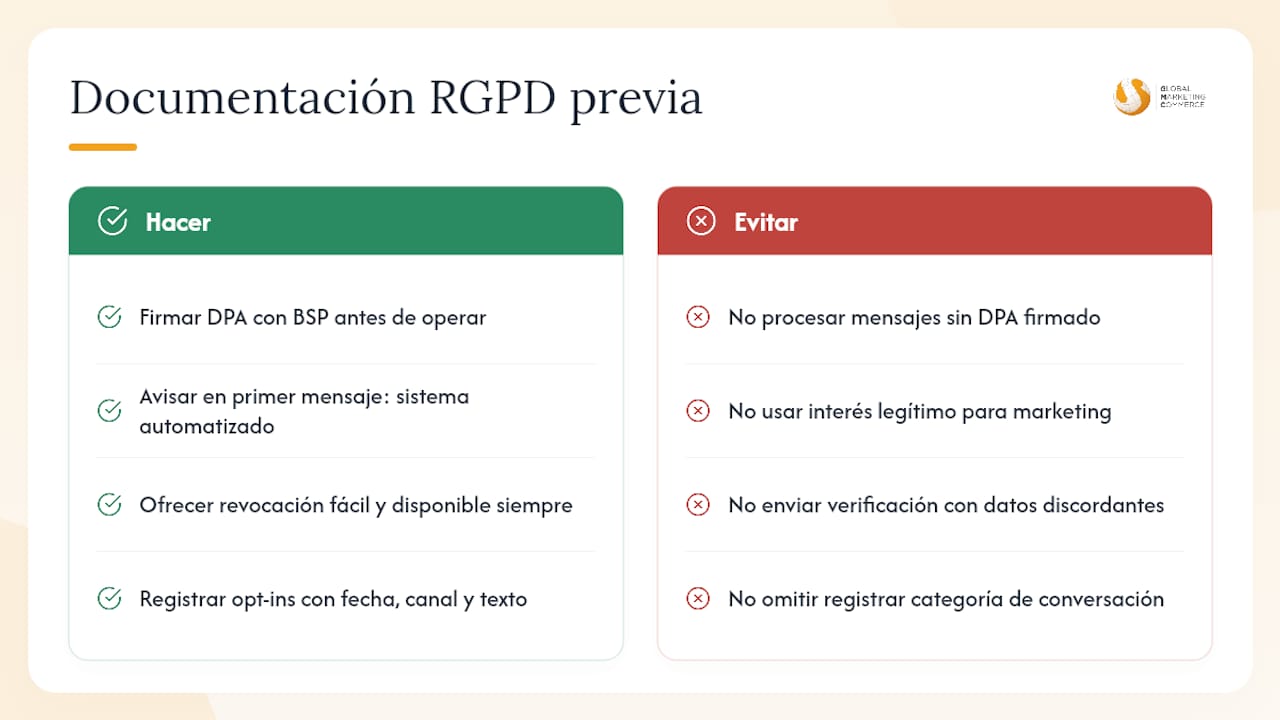
There are four key obligations. First, sign a data processing agreement (DPA) with your API provider or BSP before processing any message. Second, inform the user in the first message that they are interacting with an automated system, without exception. Third, offer a clear and simple mechanism to revoke consent at any time. Fourth, record and retain the consents obtained, differentiating the legal basis: legitimate interest covers responses to customer-initiated inquiries, but proactive marketing requires explicit consent.
The verification process with Meta Business Manager can take from a few days to several weeks, and the most frequent reason for rejection is documentary discrepancies: tax address, CIF or email that does not exactly match official records. Prepare this documentation before starting the process.
Internal audit checklist: DPA signed with the BSP or Cloud API provider; record of opt-ins with date, channel and exact text shown to the user; active and tested revocation mechanism; first message of the flow with automated system notice; documented data retention policy; internally identified data protection officer.
The API's conversation category model also has documentary implications: company-initiated conversations (notifications, reminders) have a different cost than user-initiated ones, and both must be recorded for GDPR auditing.
How to choose between BSP, direct Cloud API, or a ready-made platform?
There are three technical routes, and none is universally better. The choice depends on your internal resources, deployment speed, and budget.
Meta's direct Cloud API is the most economical option if you have your own development team. It offers maximum control and flexibility, but requires setup time and technical maintenance. According to Flowmatic, number and Business Manager verification is a prerequisite that can take between 1 and 4 weeks depending on the documentation provided.
A BSP (Business Solution Provider) adds a layer of interface, support, and management tools in exchange for an additional per-conversation or monthly cost. The real advantage is speed: many BSPs have pre-configured templates, support for Meta rejections, and guided onboarding. This is the recommended route for companies without a dedicated technical team.
Out-of-the-box platforms (SaaS solutions with integrated WhatsApp) allow launching in days without development. The price of that speed is less control over the number, dependence on the provider, and limitations in custom integrations.
To evaluate any provider, ask: does the number remain owned by my company or the provider? What SLA do they offer for incidents? Do they have experience with Meta verification rejections? Can I export the conversation history?
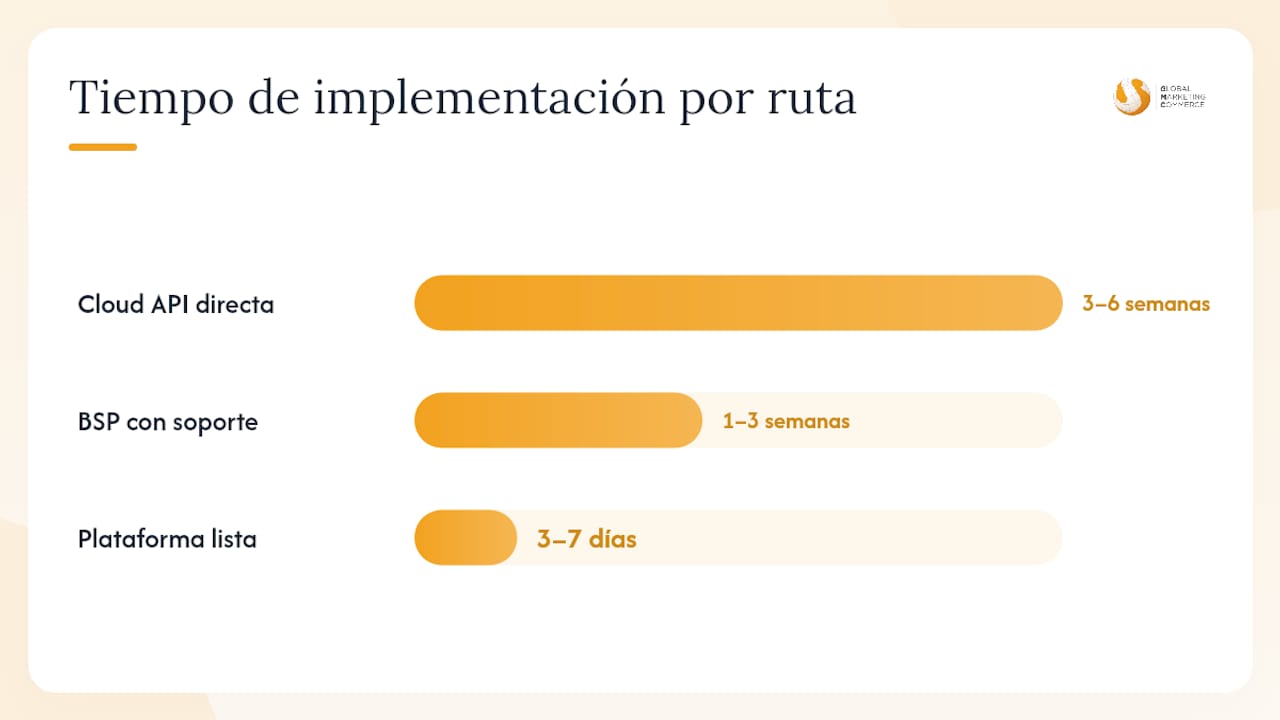
Estimated implementation time: Direct Cloud API, 3–6 weeks with own technical team. BSP with support, 1–3 weeks. Ready-made platform, 3–7 days for basic functions.
What makes a conversational flow truly work?
The most frequent error when implementing WhatsApp support is not technical: it's design. A bot that doesn't know when to hand over to a human generates more frustration than silence. Well-designed chatbots resolve between 70% and 85% of frequent queries, but that range is only achieved with a solid knowledge base and clear escalation criteria.
The design rules that make a difference are few and concrete: messages under 160 characters whenever possible, guided options using buttons instead of free text, a maximum of 4–5 steps per flow before offering an exit to a human agent, and explicit confirmation when closing each interaction.
Escalation criteria to a human agent must be defined before launch: unrecognized intentions after two attempts, language that expresses frustration or urgency, request for sensitive data (banking, medical, legal), and accumulated waiting time exceeding the agreed SLA.
Pro tip: Review weekly the conversations the bot didn't resolve. That record is your best training source: every failed conversation reveals a gap in the knowledge base or poorly calibrated escalation criteria.
4-week pilot plan for risk-free launch
A controlled pilot with a dedicated number is the safest way to validate the channel before scaling investment.
Week 1. Meta Business Manager verification, DPA signing with the provider, dedicated number setup, and activation of welcome and absence messages. Responsible: technical and legal team.
Week 2. Loading pre-approved templates (order confirmation, payment reminder, FAQ response), basic flow setup, and internal testing. Responsible: marketing and operations.
Responsible: operations.
KPIs and SLAs to govern the channel from day one
Measuring from day 1 is not optional: without metrics, there is no way to justify the investment or detect problems before they affect reputation.
Weekly reporting should fall to operations; legal monitoring (opt-outs, data incidents) to the data protection officer; and conversion analysis to marketing. Three roles, three different frequencies, one same channel.
Integrations that generate return from week one
The integrations with the highest immediate return are not the most complex. Automating invoice sending and payment reminders with a direct action button reduces the average collection time (DSO) in SMEs that implement this messaging, according to data from YoFacturo. That is real liquidity, not a user experience improvement.
Other integrations with fast ROI: automatic order confirmation with tracking number, appointment scheduling with a direct link to the calendar, and service status notifications that eliminate repetitive incoming calls. Each of these reduces support tickets and frees up agent time for higher-value conversations.
To measure ROI, define a baseline metric before launch: current DSO, number of incoming calls per week, or conversion rate in quote follow-up. Without that baseline data, any improvement lacks context.
Global Marketing and Commerce: from strategy to active channel
Implementing customer service via WhatsApp with all legal, technical, and conversational design requirements covered requires more coordination than it seems. Global Marketing and Commerce works with companies in Spain to design, launch, and manage this channel completely: from Meta Business Manager verification and DPA to conversational flows and integration with CRM or billing systems.
Global Marketing and Commerce's FIRE methodology has generated over 100 million euros in new business for its clients, reducing costs up to 10 times compared to traditional methods. The approach is not just technical: it combines conversational design, database segmentation, and WhatsApp Marketing campaigns so that each conversation has a clear business objective.
If you want to know where your company stands and what concrete steps you should take, consult Global Marketing and Commerce services and request an initial diagnosis.
What most people overlook when implementing this channel
There is an obsession in the market with automation that, in my experience, leads many companies to launch bots before being clear about what problem they are solving. The correct order is the opposite: first, you define the flows that generate the most friction today (order tracking, payment reminders, appointment confirmations), then you design the bot for those specific flows, and only then do you automate.
What truly differentiates a WhatsApp channel that works from one that generates complaints is clarity in escalation. A customer who knows they can speak to a person in less than 5 minutes perfectly tolerates a bot for simple questions. A customer who feels that the bot is a barrier to reaching a human abandons and does not return. This difference is not solved by technology: it is solved by design.
Measuring from day one is not bureaucracy. It is the only way to know if the pilot is working or if you are accumulating a reputation problem that you will see in reviews three months later.
Sources
To implement safely, these are the primary sources you should consult:
The AEPD publishes specific guides on business messaging, legal bases for data processing, and model clauses for DPAs. It is the mandatory starting point for any company in Spain.
The Meta Business Help Center details the step-by-step verification process, accepted documents, and the most frequent reasons for rejection. Consult it before starting verification to avoid delays.
Openfarm's guide on WhatsApp Business API in Spain explains the conversation category model and its impact on costs, with examples applied to the Spanish market.
When evaluating a BSP, ask in writing for: the DPA contract, availability SLAs, the number portability policy, and the procedure for Meta rejections. A provider that does not deliver these documents immediately is a red flag.
For use cases and channel strategy, Global Marketing and Commerce insights include practical analyses on conversational design, segmentation, and automation applied to companies in Spain.
This article is general information and does not substitute for the advice of a qualified attorney. Consult a qualified legal professional about your particular case before acting on this content.
- AEPD — Spanish Data Protection Agency
- YoFacturo — WhatsApp Business API vs application
- SAPIENSDATAAI — WhatsApp Chatbot for businesses: complete guide 2026
- Flowmatic — Automation and WhatsApp Business API
Frequently Asked Questions
How much does it cost to use WhatsApp Business API in Spain?
The cost depends on the type of conversation: those initiated by the company (notifications, reminders) have a different rate than those initiated by the user. To this is added the cost of the BSP or of own development if you use direct Cloud API.
Can I use my current WhatsApp number with the API?
Yes, but migrating a number that is already in the app requires planning: the number becomes inaccessible in the app during the process. Therefore, it is recommended to use a dedicated number for the API from the beginning.
What happens if I don't comply with GDPR on my WhatsApp channel?
The AEPD can sanction data processing without a legal basis, without a signed DPA, or without a revocation mechanism. In addition, users can report directly if they do not receive information about the automated system.
How long does Meta Business Manager verification take to resolve?
Discrepancies in tax address, CIF (tax identification number), or email are the most frequent causes of rejection and delay.
What automatic resolution rate can I expect from a chatbot?
Achieving that range depends on the quality of the knowledge base and having clearly defined escalation criteria to a human agent.